
Managing construction delays is usually talked about after the fact — as a postmortem, a lessons-learned document, a line in a report explaining why a milestone slipped. What gets less attention is the actual work of managing a delay while it’s still happening, when the schedule is already behind and every decision from that point forward either recovers time or loses more of it.
Here’s what that looks like in practice, using Sagheer Avenue G+6, a mixed-use residential and commercial development in Pakistan built on a genuinely constrained site — where I worked as Civil Site Engineer with Khurram Contracting Co. from 2020 to 2022, and where site constraints made delay management a constant, not an occasional, part of the job.
This post builds on Construction Planning Process and Construction Progress Monitoring — planning sets the baseline, monitoring catches the gap, and this is what happens once that gap is real.
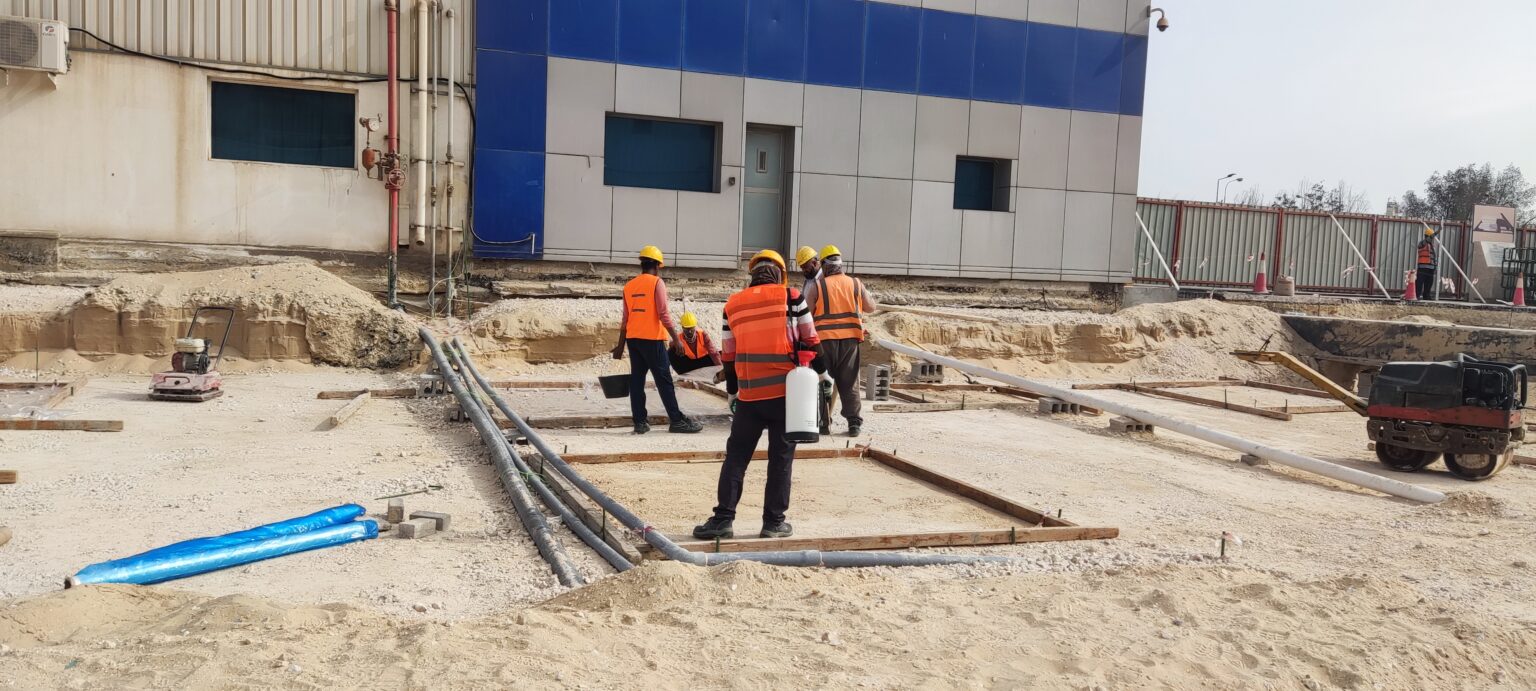
Not every delay comes from the same place. On an open site, a late material delivery is usually solvable with extra laydown space or a rerouted delivery schedule. On a constrained urban site like Sagheer Avenue — a mixed-use G+6 building with limited access and no real room for material staging — the same late delivery becomes a much tighter problem, because there’s nowhere to store materials early and no flexibility to simply work around a blocked access point. Site constraints don’t cause more delays by themselves, but they remove most of the easy ways to absorb one once it happens.
Before managing a delay, it helps to be honest about where they actually come from — and on a real project, it’s rarely one single cause:
Drawing conflicts caught late — a clash between disciplines discovered on site instead of during shop drawing review costs far more time than the same issue caught on paper.
Approval turnaround — waiting on a consultant response for an RFI or a material submittal, especially when the item sitting idle is blocking multiple trades behind it.
Access and site constraint issues — on a tight urban footprint, one blocked access route or one trade occupying the only available staging space can hold up several others.
Labor and subcontractor availability — a subcontractor finalized late, or one pulled onto another job mid-project, both create gaps the schedule wasn’t built to absorb.
Weather and unforeseen site conditions — impossible to plan away entirely, but the impact depends heavily on how much slack existed in the schedule beforehand.
The earliest sign of a delay is rarely dramatic — it’s a daily progress report showing slightly less completed than planned, two days in a row. This is exactly why consistent construction progress monitoring matters: a two-day gap caught in week one is a small adjustment. The same two-day gap, unnoticed until the monthly report, has usually already become a two-week problem by the time anyone acts on it.
Once a delay is confirmed, the options for recovering time are narrower on a site like Sagheer Avenue than they would be elsewhere, which makes choosing the right one matter more:
Reordering trade coordination where possible — on a constrained footprint, this usually means finding which floors or zones can accept a trade earlier than planned, rather than trying to compress the whole schedule evenly.
Adding shifts or crew size on the critical path only — throwing extra labor at every trade is expensive and often physically impossible on a tight site; targeting only the activity actually holding up the schedule is what makes a difference.
Escalating stuck approvals directly — a technical query or RFI sitting with the consultant longer than expected is often the fastest recovery point available, since resolving it can unblock several trades at once.
Rebuilding the schedule in Primavera P6 around the new reality — once a delay is confirmed, working from the original schedule stops being useful. A recovery schedule, built around actual current progress, gives everyone a realistic target instead of chasing a plan that’s already wrong.
On a G+6 building, delay recovery rarely happens evenly across the whole structure at once. It’s more realistic to recover time floor by floor — accepting that one floor may stay behind while resourcing is concentrated on getting an earlier floor back on track, since a fully caught-up floor can then release trades to work on the next one without a bottleneck following them up. This is slower to explain than “work faster,” but it’s closer to how recovery actually happens on a site with real physical constraints.
How a delay gets communicated matters almost as much as how it gets recovered. An internal weekly report can and should be direct about a delay’s real cause and impact. A client-facing report needs the same honesty, framed around what the client and consultant actually need to decide — whether a variation is needed, whether a milestone date has to shift, and what’s being done about it. Delaying that conversation, or softening it past the point of usefulness, tends to cost more trust than the delay itself.
What are the most common causes of construction delays?
Drawing conflicts caught late, slow approval turnaround, site access or staging constraints, subcontractor availability, and weather or unforeseen site conditions are the most frequent, though most real delays involve more than one of these overlapping.
How can construction delays be prevented on a constrained site?
They can’t be fully prevented, but the impact can be reduced — through earlier shop drawing review, tighter RFI turnaround, and realistic staging plans that account for limited site space from the start rather than assuming flexibility that isn’t there.
What is a schedule recovery plan?
A revised schedule built around a project’s actual current progress rather than its original baseline — used once a delay is confirmed, so the team is working toward a realistic target instead of a plan that no longer reflects reality.
How do you recover time on a multi-storey building with limited site space?
Often floor by floor rather than across the whole structure at once — concentrating resources on getting one floor caught up so it can release trades to the next, rather than spreading extra resourcing evenly across a site with no room to absorb it.
Aown Muhammad is a Project Engineer based in Dammam, Saudi Arabia, registered with the Saudi Council of Engineers (SCE) and the Pakistan Engineering Council (PEC), with 7+ years of experience across residential, commercial, and industrial construction projects in Pakistan and Saudi Arabia. View full portfolio and projects →