
Construction progress monitoring sounds like a straightforward idea — check what’s been done, compare it to what should have been done, report the difference. In practice, it’s one of the most easily under-done parts of running a project, because the value of a progress report is invisible right up until the day someone needs it to make a real decision, and it isn’t there, or it isn’t accurate.
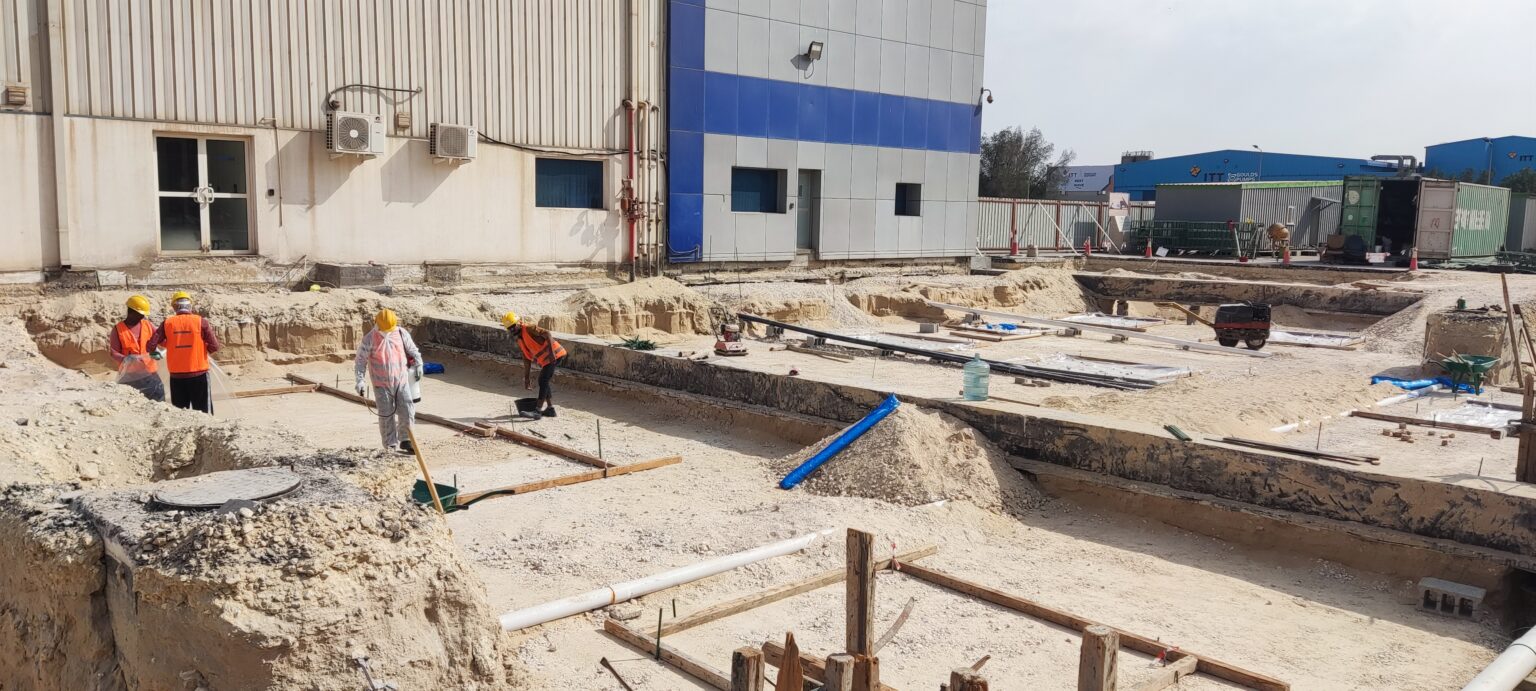
Here’s how progress monitoring actually works across the daily, weekly, and monthly layers, using the EBARA Pumps Expansion in Dammam, Saudi Arabia — an active industrial project where monthly reporting carries an added layer most projects don’t have: submissions to MODON, the Saudi Authority for Industrial Cities and Technology Zones.
This post follows on from Construction Planning Process: How Project Engineers Keep Projects on Schedule — planning sets the baseline; progress monitoring is what checks reality against it.
It’s worth separating these two, because they get treated as interchangeable and they aren’t. Progress reporting is the output — the document that goes to a client, a consultant, or an authority. Progress monitoring is everything that has to happen before that document can be written honestly: site walks, photo records, subcontractor check-ins, and an ongoing comparison against the approved schedule. A report built without real monitoring behind it is just a status update with no actual basis — and on an industrial site with dense underground utilities and multiple disciplines working in parallel, that gap shows up fast.
Everything above the daily level depends on what gets captured here. A daily progress report on an active site typically covers what work was completed that day, what’s planned for tomorrow, any delays or issues encountered, and photo documentation of the day’s activity. On EBARA Pumps Expansion specifically, daily records also need to capture excavation progress against the confirmed utility clearance plan — since that’s the single biggest risk factor on this project, a gap in the daily record here isn’t just an administrative miss, it’s a real risk to catching a problem late.
The habit that matters most at this level isn’t the format of the report — it’s consistency. A daily report written carefully some days and rushed through on others produces a record that can’t really be trusted when it’s needed most, which is usually during a dispute or a delay, not during a calm week.
Weekly reporting splits into two distinct audiences, and conflating them is a common mistake. An internal weekly report is for project management — it can be blunt, it can flag risks in plain terms, and its job is to surface problems early enough that something can still be done about them. A weekly progress report to the client and consultant is a different document with a different tone: still honest, but framed around what they need to know to make decisions on their end — schedule status, any approvals needed from them, and upcoming milestones.
On EBARA Pumps Expansion, the weekly cycle is where civil and MEP coordination status gets reviewed together — checking whether clash detection findings from the past week have actually been resolved on site, not just logged and forgotten.
Monthly reporting is where construction progress monitoring rolls up into its most formal shape. For most projects, that means a monthly report to the client and consultant summarizing overall progress, cost status, and any variations. For an industrial project like EBARA Pumps Expansion, it also means a separate monthly submission to MODON, following that authority’s own documentation format and requirements.
This is where the daily and weekly layers really prove their worth. A clean, consistent daily record makes the monthly MODON submission straightforward — pulling together data that was already captured accurately, rather than reconstructing a month of activity from memory or scattered notes right before a deadline.
Photo documentation, daily logs, and progress reports all need somewhere to live consistently, and scheduling software plays a real role here too. Tracking actual progress against the baseline in Primavera P6 — the same tool used for the planning process — means progress monitoring and planning are working from the same underlying schedule, rather than two separate documents that quietly drift apart from each other over time.
None of this matters if monitoring stops at reporting and never feeds back into a decision. Progress monitoring exists to answer one practical question, over and over: is this project still on track, and if not, what needs to change? On EBARA Pumps Expansion, that loop connects directly back to the planning process — a delay caught in a weekly report can trigger a resource plan adjustment before it becomes a monthly-report-level problem, which ties straight back into everything covered in Construction Planning Process.
A few patterns show up repeatedly on projects where monitoring stops being useful:
Reports written from memory instead of the daily record — usually happens under time pressure, and it’s the fastest way to lose trust in a report once a mistake surfaces.
Weekly internal and client reports blurred into one document — either too blunt for the client, or too polished to be useful internally.
Monitoring data that isn’t structured for the monthly requirement — daily records that don’t map cleanly onto what MODON or a similar authority actually needs, forcing a rebuild at month-end instead of a simple roll-up.
Monitoring treated as a paperwork task, disconnected from planning — a report gets filed, but nothing about the resource plan or schedule changes in response, even when the data clearly calls for it.
What’s the difference between construction progress monitoring and progress reporting?
Monitoring is the ongoing process of tracking real site activity — site walks, photo records, schedule comparisons. Reporting is the document that summarizes that monitoring for a specific audience, whether that’s internal management, a client, or an authority like MODON.
How often should progress be monitored on a construction project?
Continuously in practice, even though it’s formally reported on daily, weekly, and monthly cycles. The daily layer is what makes the weekly and monthly reports accurate rather than reconstructed after the fact.
What is MODON reporting, and which projects require it?
MODON is the Saudi Authority for Industrial Cities and Technology Zones. Projects located within its jurisdiction — typically industrial developments — require monthly progress submissions in a format specific to that authority, in addition to standard client and consultant reporting.
Why do internal and client-facing weekly reports need to be different documents?
Because they serve different purposes. An internal report needs to surface risk early and plainly, even when the news isn’t good. A client-facing report needs to inform decisions the client and consultant are actually responsible for, without unnecessary internal detail that isn’t useful to them.
Aown Muhammad is a Project Engineer based in Dammam, Saudi Arabia, registered with the Saudi Council of Engineers (SCE) and the Pakistan Engineering Council (PEC), with 7+ years of experience across residential, commercial, and industrial construction projects in Pakistan and Saudi Arabia. View full portfolio and projects →